Tuesday, July 14, 2026

Fairy Rings: Myth and Nature
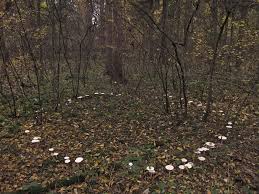
You have probably come across one of these as you walked through woodland somewhere.
You will have smiled at the strangeness of those mushrooms growing in a ring shape, as though avoiding the centre for some reason. Of course there is a perfectly logical, scientific explanation, but the fantasy is so much more interesting.
Fairy rings, as they have long been called, have occupied a popular place in folklore for thousands of years.
While science would call them naturally occurring rings of mushrooms, folklore tells us that these strange formations are actually the work of supernatural beings.
They are portals to other worlds or strange remnants of dancing faery folk. Of course, those are just stories, right?
Don’t ever step into a fairy ring
Fairy rings have other names: Elf Circles, Sorcerers or Witches Rings. The folklore surrounding these strange circles can be found in many cultures, each with slightly different variations.
For example, in German folklore, these rings are thought to be spots where witches dance on Walpurgis Night, a spring festival that lies exactly six months from All Hallows’ Eve.
In Celtic folklore, on the other hand, fairy rings are said to be caused by dancing faeries, or burned into the ground by dancing elves and left to appear in the morning after a moonlit night.
Whatever the case, it is said you should never enter a fairy ring, or else you will be cursed by their otherworldly protectors. You may even find yourself whisked away into the fairyland, or perhaps even driven mad.
Myths tell of mortal people entering fairy rings and suffering for it. Some believe that anyone stepping into an empty fairy ring will die young.Those violating fairy perimeters become invisible to those outside and may be unable to leave the circle.The fairies force intruders to dance till exhausted, dead, or in the throes of madness.
The only safe way, according to some beliefs, to investigate a fairy ring is to run around it nine times only (a tenth lap would nullify the effect). Doing this allows the runner to hear the fairies dancing underground. It must be done under a full moon, and in the direction the sun travels during the day.
It is also said that wearing a hat backwards confuses the fairies and stops them from doing the wearer any harm.
There are many sites in the UK where fairies are believed to be regular visitors, though always apparently at full moon. For example, “The Pixies’ Church” is a rock formation in Dartmoor surrounded by a fairy ring; and a stone circle at Cader Idris in Wales that is believed to be a popular spot for fairy dances.
A Devon legend says that a black hen and chickens sometimes appear at dusk in a large fairy ring on the edge of Dartmoor.
Victorian society believed that fairies, elves and witches were closely associated with one another, and malevolent towards humans. In Scotland is said that the mushrooms were used as seats and tables for dining by the magical beings, while in Welsh is claimed that the fungi were used as umbrellas.
Twenty-first century beliefs in parts of the UK still hold firm to stories of fairy activity, and many think of them as omens of good fortune. Despite of those who associated them with ill luck, some legends see fairy circles as places of fertility and fortune. Welsh folk believe that mountain sheep eating fairy grass flourish, and crops sown around them do far better than those planted elsewhere.
Fairy rings also occupy a prominent place in European folklore as the location gateways into elfin kingdoms, or places where elves gather and dance. They are called “Sorcerers’ Rings” in France, and “Witches’ Rings” in Germany, where folk believe they are most active on “Walpurgisnacht”, Halloween to us. According to stories, a fairy rings appear when a fairy, pixie, witch or elf is near.
The Dutch believe that the empty centre of the fairy ring occurs because the devil puts milk-churn there. Austrian folklore has it that fairy rings are created by flying dragons, and once created, nothing but toadstools could grow there for seven years. French belief is that fairy rings are guarded by giant toads that curse any violating the circles.
Elsewhere in Europe, entering a fairy ring could cost the intruder an eye. This can be alleviated where rabbits are abundant, because they crop the grass short but leave the toadstools alone. Their droppings are rich in Nitrogen, so over time they will replenish what earlier plant grow had taken out of the soil. In time a secondary circle of mushrooms could appear in the centre of the original circle, creating an unusual “double ring”, witch folklore has it it is especially magical.


Friday, November 7, 2014
PLAYING CARDS IN EUROPE
- 13 in the commonly-known French deck,
- 14 in the French Tarot game,
- 10 in Spain,
- 10 in Italy and in some games in Spain,
- 9 in Switzerland for the Jass,
- 8 in some games in Germany and Austria, e.g. Skat
- 8 for Belote in France,
- 5 in Hungarian Illustrated Tarock,
SPAIN

ITALY


SWITZERLAND

My intention in CelticJourney was to create a special deck of playing cards that would have the essence of Ireland, its culture and its art.
The suits of this deck are based on artifacts of the Irish culture:
Jacks, Queens and Kings in each of the suits relates to a figure from the Irish Mythology, having the whole deck 12 different figures.
The detailed art-work and the vibrant colours used in my designs make the onlookers stop and have a closer look, to be taken then into a journey.It is then, that from distant past, come tales of Gods, giants and heroes.


Sunday, March 23, 2014
BRIDGET

Her name comes from the old Irish brigh, meaning "power" and is considered a classic Celtic Triple Goddess.
In Celtic religion and Irish Mythology is the daughter of the Dagda and one of the Tuatha De Danann.
She was the wife of Bres of the Fomorians, with whom she had a son, Ruadan.
She had two sisters, also named Brighid.
She was the great mother Goddess of Ireland.
At one time in history most of Ireland was united in praise and worship of her. She was probably one and the same with Dana, the first great mother Goddess of the Irish.
Bridget represents the supernal mother, fertility and creative inspiration.
She was also worshiped as a warrior and protector,
a healer, a guardian of children, a slayer of serpents,
a sovereign and a Goddess of fire and the sun.
Sunday, June 9, 2013
PYROGRAPHY

Pyrography or pyrogravure is the art of decorating wood or other materials with burn marks resulting from the controlled application of a heated object such as a poker. It is also known as pokerwork or wood burning.
The term means "writing with fire", from the Greek pur (fire) and graphos (writing).It can be practiced using specialized modern pyrography tools, or using a metal implement heated in a fire, or even sunlight concentrated with a magnifying lens.
A large range of tones and shades can be achieved. Varying the type of tip used, the temperature, or the way the iron is applied to the material all create different effects. After the design is burned in, wooden objects are often coloured. Light-coloured hardwoods such as sycamore, basswood, beech and birch are most commonly used, as their fine grain is not obtrusive. However, other woods, such as pine or oak, are also used. Pyrography is also applied to leather items, using the same hot-iron technique. Leather lends itself to bold designs, and also allows very subtle shading to be achieved. Specialist vegetable-tanned leather must be used for pyrography (as modern tanning methods leave chemicals in the leather which are toxic when burned), typically in light colours for good contrast.Pyrography is also popular among gourd crafters and artists, where designs are burned onto the exterior of a dried hard-shell gourd, usually with dramatic results.
The process has been practiced by a number of cultures including the Egyptians and some African tribes since the dawn of recorded history. Pyrographer Robert Boyer hypothesises that the art form dates back to prehistory, when early humans created designs using the charred remains of their fires. It was known in China from the time of the Han dynasty , where it was known as "Fire Needle Embroidery". During the Victorian era , the invention of pyrography machines sparked a widespread interest in the craft, and it was at this time that the term "pyrography" was coined (previously the name "pokerwork" had been most widely used).In the late 19th century, a Melbourne architect by the name of Alfred Smart discovered that water-based paint could be applied hot to wood by pumping benzoline fumes through a heated hollow platinum pencil .This improved the pokerwork process by allowing the addition of tinting and shading that were previously impossible. In the early 20th century, the development of the electric pyrographic hot wire wood etching machine further automated the pokerwork process, and Art Nouveau pyrographic glove-boxes and other works were popular in that era. Pyrography is a traditional folk art in many parts of Europe, including Romania, Hungary and Flanders, as well as Argentina and other areas in South America.

Candle holder that I decorated with Celtic design using pyrography.

Selection of items I have engraved so far
